
How to Prepare for Goat Kidding Season and What We Can Learn From Goats
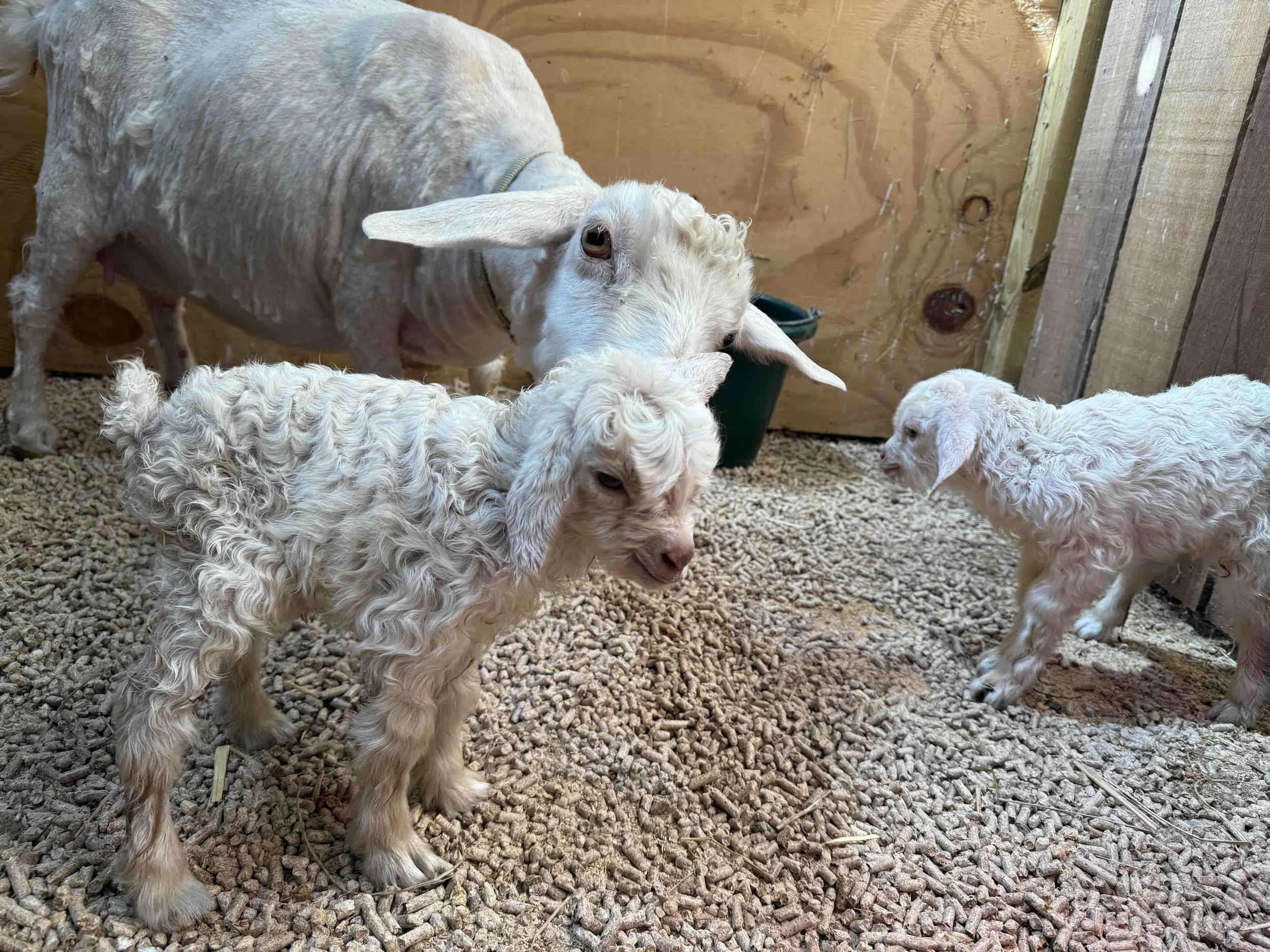
Earlier this summer I dropped off a buckling to a newer Pygora owner who plans to breed this fall for the first time. She also happens to be pregnant with her own first child. As we chatted about the set up she will need for kidding season I began to realize that the recommendations I had for kidding best practices are strikingly similar to my tips for first-time moms. It was the first time I had realized how much we could perhaps learn from goats.
If you are headed into your first fall breeding season, here are a few tips from years of experience:
(1) Know Your Due Dates – Just like us, knowing your does’ due dates makes kidding season a lot less stressful on everyone. On our farm, we do selective breeding, meaning we watch the does for heat signs and put them with the buck when they are ready. At our farm, our doe field is separated from the buck field by about 25 feet, and when a doe is in heat she lingers near the fence and often calls or “flags” by wagging her tail. The boys respond by calling back and occasionally pacing the fence. When the doe is ready, we move her to our breeding pen in between the two fields and then bring over the buck of choice. A doe in heat will stand for breeding. One not in heat will run or fight, so if you’ve missed the signals you know right away. Unlike humans, goats don’t seem to value a long courtship. The deed is generally done in a matter of minutes, sometimes seconds. We often repeat the breeding the next day as the doe is usually still in heat, then we write down the date of first breeding and use an online goat gestation calculator to calculate and record the kidding date. Importantly, because Pygoras carry genetics from both a standard size and miniature breed, I calculate and record both dates. Kidding usually happens somewhere in the middle of the two.
Some breeders prefer to simply move their buck in with their does. This can also work but I strongly recommend you don’t leave the buck with the does too long. Pygoras cycle every 21 days, so you can simply pick a 3-week window, and you are more than likely to catch your entire herd. You will then have a kidding window about a month long.
(2) Set Up Kidding Pens – If you own goats, you know they are true herd animals. They are always together. But, when a doe is ready to kid, she will find a quiet isolated spot for the big moment. Ideally, when you begin to see early signs of labor, you will want to move your doe to a small, secure pen set up for her quiet time. Note though, that if you catch it later in the process it is best not to move her. My kidding pens are 4x4 and 4x6 in size, so you don’t need a ton of space.
Your kidding pens can have solid walls or 4x4 wire panel walls, but you can’t use cattle panel or any wire larger than 4x4 as kids will walk right through. You will also want a way to securely hang a heat lamp if you are kidding on colder spring days. Goats are born in the sac so are completely wet until mom (or you as support staff) gets them dry. The most common way to lose a kid is for it to be born in freezing temperatures and simply not get dry fast enough to survive. If my kidding window falls during a spring cold snap, I often move does into kidding pens at the beginning of the 5-day window and run heat lamps overnight just in case I miss the signs of early labor. It’s important in that situation that they have a next-door neighbor or stall buddy so that they aren’t lonely before they are ready for isolation.
(3) Plan for Bonding Time – If you were waiting to find out how my first-time-mom tips were similar to my kidding tips, this is the big one. After your doe kids, give her plenty of hay and water and extra grain at feeding time and leave her in that kidding stall with those babies. I also recommend deworming and giving a dose of Red Cell or Vitamin B Complex gel the day after. At a minimum, your doe and her kids need to be together alone for three days, but I strongly recommend not moving them for the first week. Does, especially first-timers, need that time to bond with their kids and settle into nursing. Integrating them back into the herd too early can cause stress that can create lots of other health problems.
My recommendation for first-time moms is exactly the same. No one really tells you how all-consuming breast feeding can be, especially right after birth. They also don’t tell you that your body needs time to adjust to your baby’s needs without distraction. So, light up that network of friends and family members who want to help and give them all an assignment – meal prep, dish/bottle washing, take the trash, etc. – so that you can simply lay around in your bedroom with your baby for a week. Rest, eat and feed. Nothing else. Have people bring in your meals and hold your baby for an occasional shower. That’s what we do with our goats, and it works.
(4) Kidding Supplies to Keep on Hand – You’ll want to have a few things ready to go in the barn once you are in that 5-day kidding window:
Garbage bags and latex gloves – Kidding can be messy. You’ll want to clean up the kidding pen a bit after delivery, including disposing of the placenta, which is delivered usually 1-3 hours after kids are born. A doe will often attempt to eat the placenta, which actually has good nutrients in it, but I typically dispose of them and give Red Cell iron supplement instead.
Old towels and Hair Dryer – We usually help dry the kids, not immediately after birth but once mom has done most of the work and the kid has stood up and nursed. They need to nurse within the first hour after delivery but can usually figure that out on their own. Once they have nursed, we help ensure they are dry and clean of stuck-on dirt from the barn floor. If it is below freezing, we also gently blow them dry with a hair dryer.
Uncented Dental Floss, Sharp Scissors and Iodine – During that same drying session, we tie off their umbilical cord if mom hasn’t already bitten it off with dental floss and cut just above the knot. Then we apply iodine to the cut cord to protect from infection.
Scale for Weighing – This isn’t required, but it can be helpful to record birth weight. I use a kitchen scale and large mixing bowl. We set the baby in the bowl butt first and settle them until they aren’t wiggly to capture birth weight.
Birthing Gloves and OB gel – There is always the chance that a kid will be positioned incorrectly and assistance will be needed during birth. Kids should be born within an hour of seeing amniotic fluid (amber or clear thin liquid) or the amniotic sac. A twin should come no more than an hour after the first, and usually it is much sooner. If you are new to kidding, I strongly recommend finding a nearby experienced goat or sheep farmer who can be on call in case birthing assistance is needed. They can coach you through an assisted birth. If possible, it’s also great to have a vet on call.
All this may sound a little intimidating, but as I like to say, there’s just nothing cuter than a baby Pygora. Once you have them on your farm, you are sure to want more. And surely, if we manage to navigate our own way through parenthood, we can certainly handle playing the support role for our goats.
And remember, if someone in your network is pregnant with their first child, let them know you’ll bring a meal that first week and wash the dishes and take out the garbage when you stop by. Human or goat, all moms deserve a week to rest, bond and fuel up for the difficult but rewarding role of motherhood.